Building Instabase's icon system from zero — one grid, five industries, 250+ icons.
Project Timeline
2021 – 2024
Industry
Software/Technology (Enterprise SaaS)
Scope of work
Icon Design
Scalable System
Intuitive Iconograhy
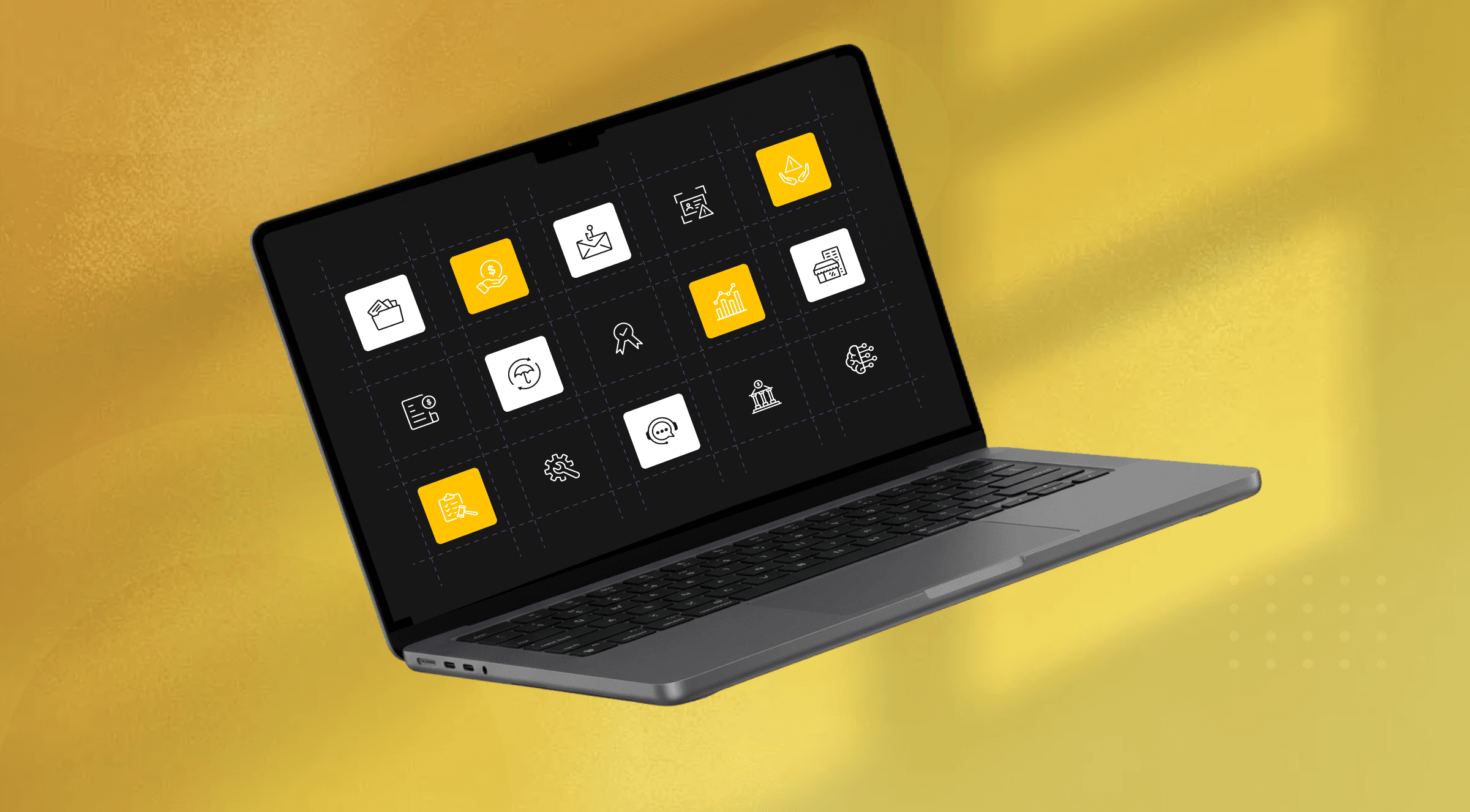

Icons at Scale: Building a Custom Icon System for Enterprise AI
250+ icons. Five categories. Three sizes. Four industries. Zero brief. Over three years, it shipped across 60+ resources, 20+ decks, and 18+ tradeshow backdrops— and every internal team had access, making actual reach far wider.
Designing icons wasn't the hard part. The hard part was designing a system flexible enough to work across four industries — Documents, Banking & Finance, Insurance, and Database & AI — while still feeling like it came from one brand. There was no precedent, no style reference, no brief. Just a gap that needed filling.
Built from scratch on a structured grid — 250+ icons, five categories, three sizes. Size variants were intentional: simple icons adapted through stroke adjustment, complex icons redrawn to preserve legibility. Designed to scale — new icons could be added without breaking cohesion. By 2023, it was distributed as an internal PNG library available to every team.

System Icon Library
Showing a representative sample across categories. The full library comprises 250+ icons available in three sizes — small, medium, and large.


Design Decisions
Grid, keylines, stroke, and corner radius were defined upfront — not to constrain the work, but to make 250+ icons feel like they came from one hand.
Size variants were intentional. Simple icons adapted through stroke adjustment. Complex icons were redrawn.
Deployed at Scale
The system became the visual backbone of Instabase's marketing. In my own work alone — decks, campaigns, tradeshows, blogs, whitepapers, banners, social assets — it shipped across 60+ resources, 20+ decks, and 18+ tradeshow backdrops. Beyond that, every internal team had access to the PNG library. No one tracked it. Actual reach was far wider.


What I'd Do Differently
The system grew organically, which meant documentation was always secondary. Icons were added as needs arose, color variants multiplied based on requests, and usage guidelines were never formalized. Internal teams had access to the PNG library but no guidance on when to use which size, which color variant, or how to request new icons. If I were building this today, I'd treat documentation as part of the deliverable — not an afterthought.